
Fulton County Court Records After a Jail Arrest
After a Fulton County arrest, the custody side and the court side can split quickly. The person may be processed locally, arraigned before a magisterial district judge, and if not released, committed to a contracted facility such as Bedford County Correctional Facility. The court record begins with the criminal paperwork: complaint, docket number, OTN when assigned, bail entry, hearing dates, and charge list. Fulton County is in Pennsylvania's 39th Judicial District with Franklin County, so a case may begin in a Fulton magisterial district court and later move into the Court of Common Pleas if charges are held for court.
The booking or jail record may identify the arresting agency, intake date, current custody status, and a preliminary charge label. A court record is different. It is the official docket where filed charges, amendments, reductions, dismissals, bench warrants, bail orders, pleas, sentencing, and final dispositions are recorded. For custody and booking details, use the jail inmate records path. For the case that follows the arrest, use Pennsylvania UJS Case Search and the Fulton County court offices listed below.
How to Find Fulton County Court Records After an Arrest
The main online court lookup is Pennsylvania UJS Case Search. UJS is the public statewide docket portal for Magisterial District Court and Common Pleas cases. Search both levels when a Fulton County arrest is recent, because early events often appear first in an MDJ docket, while felony and misdemeanor cases that are held for court move into Common Pleas. UJS warns that recent entries may be delayed and that docket sheets are not criminal-history background checks.
The UJS search screen is the source most users need after a Fulton County jail arrest.
Open Pennsylvania UJS Case Search to search by name, docket number, OTN, or date when those details are available.
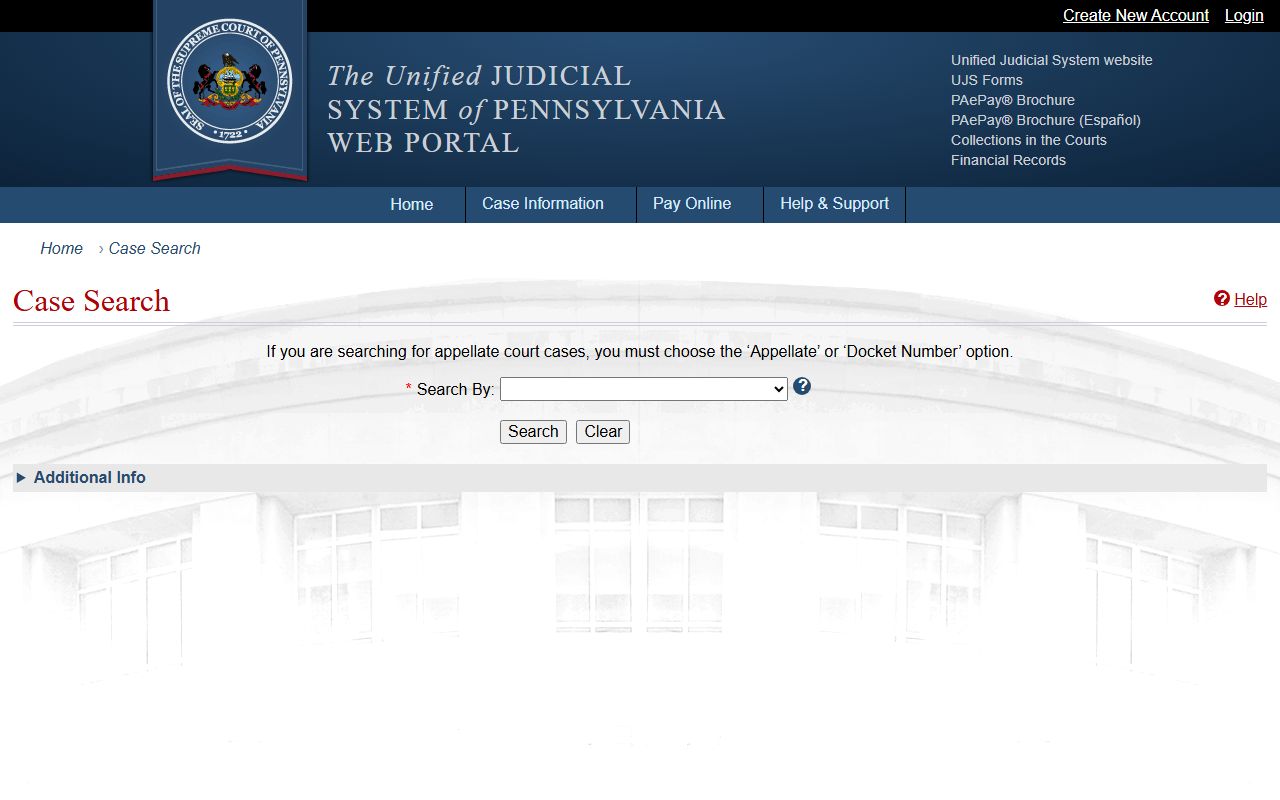
Use this court search with the jail or facility record. The docket may show a filed case even when the person has already posted bail, been transferred, or no longer appears in a custody listing.
- Open UJS Case Search and choose the court type or docket category that fits the case stage.
- Search by participant or defendant name, docket number, OTN, complaint number, or event date.
- Select Fulton County when the search form provides a county filter, and check both MDJ and Common Pleas results when necessary.
- Open the docket sheet and read each charge line, event, bail entry, and disposition instead of relying only on the summary result.
| UJS Field | How It Helps After Arrest |
|---|---|
| Court type / docket category | Switches between Magisterial District Court, Common Pleas, appellate, and other UJS categories. |
| Search type | Lets the user search by participant name, docket number, OTN, complaint number, incident number, organization, filing date, or calendar/event data when available. |
| County | Use Fulton for local cases; remember that Common Pleas administration is part of the 39th Judicial District with Franklin County. |
| Participant / defendant name | Best starting point when only a name is known. Add first name or date limits for common names. |
| Docket number | Best route when a court notice, citation, attorney letter, or bail paperwork already lists the case number. |
| OTN | A useful arrest-tracking number when it appears on criminal paperwork or a docket. |
| Date filed / event date | Narrows recent arrests, preliminary hearings, formal arraignments, warrant hearings, and scheduled case events. |
How Charges Get Filed After an Arrest: Complaint, Information, and Indictment
A Fulton County arrest commonly moves through Pennsylvania's lower-court process before any Common Pleas trial-level case is fully developed. The complaint usually starts the criminal case at the magisterial district judge level. A preliminary arraignment under Pa.R.Crim.P. 540 addresses the charges, bail, counsel opportunity, and preliminary hearing notice. If the case is held for court, the district attorney may file an information in Common Pleas. Grand-jury indictments are not the ordinary path for most local arrests, but the concept matters because an indictment is another formal charging document in criminal practice.
| Document | Who Files It | What It Does | Where to Look |
|---|---|---|---|
| Complaint | Law enforcement or prosecutor | Starts the lower-court criminal case and lists initial charges. | Magisterial District Court docket in UJS. |
| Information | District attorney | States formal Common Pleas charges after preliminary proceedings when a case is held for court. | Common Pleas docket and case filings. |
| Indictment | Grand jury | Charges by grand-jury action in cases where that procedure is used. | Common Pleas or federal court records, depending on the case. |
Charge Status in Court Records After an Arrest
Charges can change after booking. A jail intake entry may repeat the arrest charge as understood at the time of commitment, while the prosecutor and court docket may later show a different grade, statute section, count number, or disposition. Fulton County District Attorney Eric Weisbrod's office handles prosecution decisions for county criminal cases. The docket is the best public source for whether a charge is pending, withdrawn, dismissed, reduced, held for court, disposed by plea, or sentenced.
| Status | What It Means |
|---|---|
| Pending | The charge remains open and has not reached a final disposition. |
| Held for court | The MDJ found enough basis to send the charge to Common Pleas, or the defendant waived the preliminary hearing. |
| Amended / reduced | The prosecution or court changed the charge, grade, count, or description from an earlier version. |
| Withdrawn | The prosecution withdrew the charge, often before or at a preliminary-hearing stage. |
| Dismissed | The court did not allow the charge to continue or entered a dismissal. |
| Nolle prosequi | The prosecutor formally declined to continue pursuing the charge, subject to court practice and approval where required. |
| Guilty / sentenced | The charge resulted in a guilty plea, verdict, or sentence entry on the docket. |
Bail, Bond, and Release After an Arrest
Bail in Fulton County criminal cases is set by the court, not by the online roster or a private search system. Rule 540 connects preliminary arraignment to the first bail opportunity. If the defendant is detained after preliminary arraignment, the defendant must have a reasonable opportunity to post bail, secure counsel, and notify others. If bail is not posted, the person can be committed to a correctional facility. Because Fulton uses contracted prison services, the person may be held outside the county after commitment.
Common Pennsylvania bail outcomes include release on recognizance, unsecured bail, nominal bail, monetary bail, percentage cash bail, and nonmonetary conditions. Before sending money or traveling, check UJS for the bail entry, then call the appropriate MDJ, Common Pleas office, the Fulton County Sheriff, or the receiving facility. A second hold can block release even when bail is satisfied on one case.
| Bail or Hold Type | How It Works |
|---|---|
| Release on recognizance | Release based on the defendant's promise to appear, without an upfront cash payment. |
| Unsecured bail | Money is owed only if the defendant fails to comply with court requirements. |
| Monetary / percentage cash bail | The court sets a monetary condition; the exact payment method must be confirmed with the court or facility. |
| No-bail or no-release hold | Release may be blocked by a court order, detainer, probation/parole hold, warrant, state commitment, federal hold, or ICE detainer. |
Fulton County MDJ and Common Pleas Court Contacts
Fulton County's magisterial district judges are often the first court contacts after an arrest. District 39-04-01 is Devin C. Horne at 27952 Great Cove Road, Hustontown, phone (717) 987-3221. District 39-04-02 is David A. (Drew) Washabaugh V at 208 North Second Street, McConnellsburg, phone (717) 485-4842. District 39-04-03 is Tamela Mellott Heming at 8328 Great Cove Road, Needmore, phone (717) 573-2225. The Court of Common Pleas is part of the 39th Judicial District with Franklin County and hears major criminal matters after bind-over.
The county's Common Pleas and MDJ pages are useful for confirming which office handles a case event.
Open the Fulton County Magisterial District Judges page for district addresses and phone numbers.
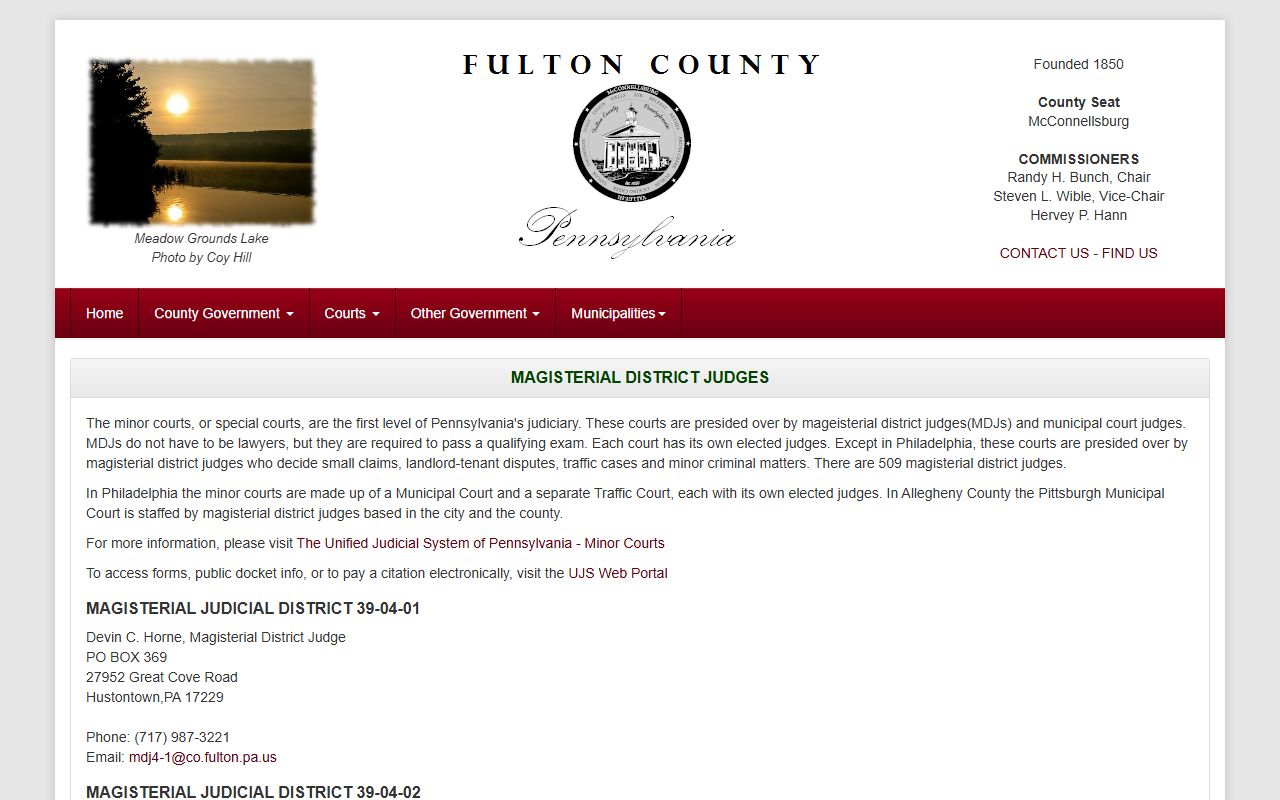
The MDJ office can be especially important when the docket shows a preliminary hearing, summary case, traffic matter, or bench warrant tied to that district.
Warrants That Lead to an Arrest
No official Fulton County active-warrant list was located on the county website in the research materials. Warrant questions may require UJS, the issuing MDJ, the Fulton County Sheriff at (717) 485-4221, Pennsylvania State Police Troop G - McConnellsburg at 717-485-3131, or Common Pleas court records. A bench warrant may appear as a docket event for failure to appear or violation of a court order. An arrest warrant can lead directly to booking and commitment. A probation or parole detainer can prevent release even if bail is posted in a new case.
Do not treat every warrant as something that can be resolved at a jail window. The safer sequence is to verify the issuing court, contact counsel or the court office, confirm bail or surrender instructions, and then follow the court's directions. If a warrant results in custody, check the jail-record portal, VINE, and the receiving facility, since Fulton County prisoners may be housed through contracted county prison services.
Charges vs. Convictions
A charge is an accusation recorded in the court system. A conviction is the result of a guilty plea, verdict, or other final criminal disposition that establishes guilt. Fulton County court records after an arrest can show both types of information on the same docket, so read the disposition column and event history before drawing a conclusion.
| Charge | Conviction | |
|---|---|---|
| Stage | Filed accusation or count in a criminal case. | Final result after plea, trial verdict, or other qualifying disposition. |
| Meaning | Shows what the person was accused of at that point in the case. | Shows that guilt was legally established for that count. |
| Can change? | Yes. Charges may be amended, reduced, withdrawn, or dismissed. | May be affected later by appeal, post-conviction relief, pardon, expungement, or limited-access rules. |
| Best source | UJS docket charge list and filings. | UJS disposition entries, sentencing order, and certified court record. |
Sealed vs. Expunged Arrest Records
Pennsylvania records are affected by the Right-to-Know Law, CHRIA, limited-access rules, expungement law, juvenile confidentiality, and court orders. A dismissal or withdrawal on a docket does not automatically mean every booking, arrest, or third-party copy disappears. The official route is to determine eligibility, obtain the required court order when available, and direct correction or removal requests to the agency or court that maintains the record.
| Sealed / Limited Access | Expunged | |
|---|---|---|
| Public visibility | Hidden from many public searches, while some authorized access may remain. | Removed or destroyed as directed by law and court order. |
| Law enforcement access | May remain available for criminal justice purposes. | More restricted, depending on the statute and order. |
| Common trigger | Eligibility under Pennsylvania limited-access rules or court order. | Eligibility under 18 Pa.C.S. § 9122 and related procedures. |
| Practical result | A public lookup may no longer show the record, but agencies may still retain controlled access. | The official record is treated as removed to the extent the law and order require. |
Background Check Considerations
UJS docket sheets are public court records, but UJS itself warns that docket sheets are not a substitute for a criminal-history background check. For official criminal history dissemination, Pennsylvania's Criminal History Record Information Act and 18 Pa.C.S. § 9121 matter. Employers, landlords, lenders, insurers, and others covered by the Fair Credit Reporting Act need compliant background-check procedures rather than casual docket searches.
Important: This private site is not a consumer reporting agency and must not be used for employment, tenant, credit, insurance, or other FCRA-covered decisions.
Restricted Court Records After an Arrest in Fulton County
Some Fulton County arrest-related records may be unavailable to the public. Juvenile matters, sealed cases, expunged records, active investigative material, protected victim information, confidential treatment information, and records restricted by court order may be withheld or redacted. The Pennsylvania Right-to-Know Law, Act 3 of 2008, presumes many government records are public unless an exemption or another law applies, but that presumption does not override CHRIA, juvenile confidentiality, expungement orders, or active-investigation limits.
When a docket is not enough, direct records requests to the office that created or maintains the record. Fulton County's open-records process accepts written requests through the county open records officer, while court-record requests may need the court office or court administrator. Provide the defendant name, date of arrest, docket number, OTN, arresting agency, and exact record requested when known.
District Attorney Review After a Fulton County Arrest
The Fulton County District Attorney is Eric Weisbrod. The office is at 116 West Market Street, McConnellsburg, PA 17233, phone (717) 485-5419, with posted hours of 8:30 a.m. to 4:30 p.m., Monday through Friday. The DA's role is not to maintain a public jail roster. The prosecutor evaluates and pursues the criminal charges that move from the initial MDJ stage into Common Pleas when a case is held for court.
Open the Fulton County District Attorney page for the county's official DA contact information.
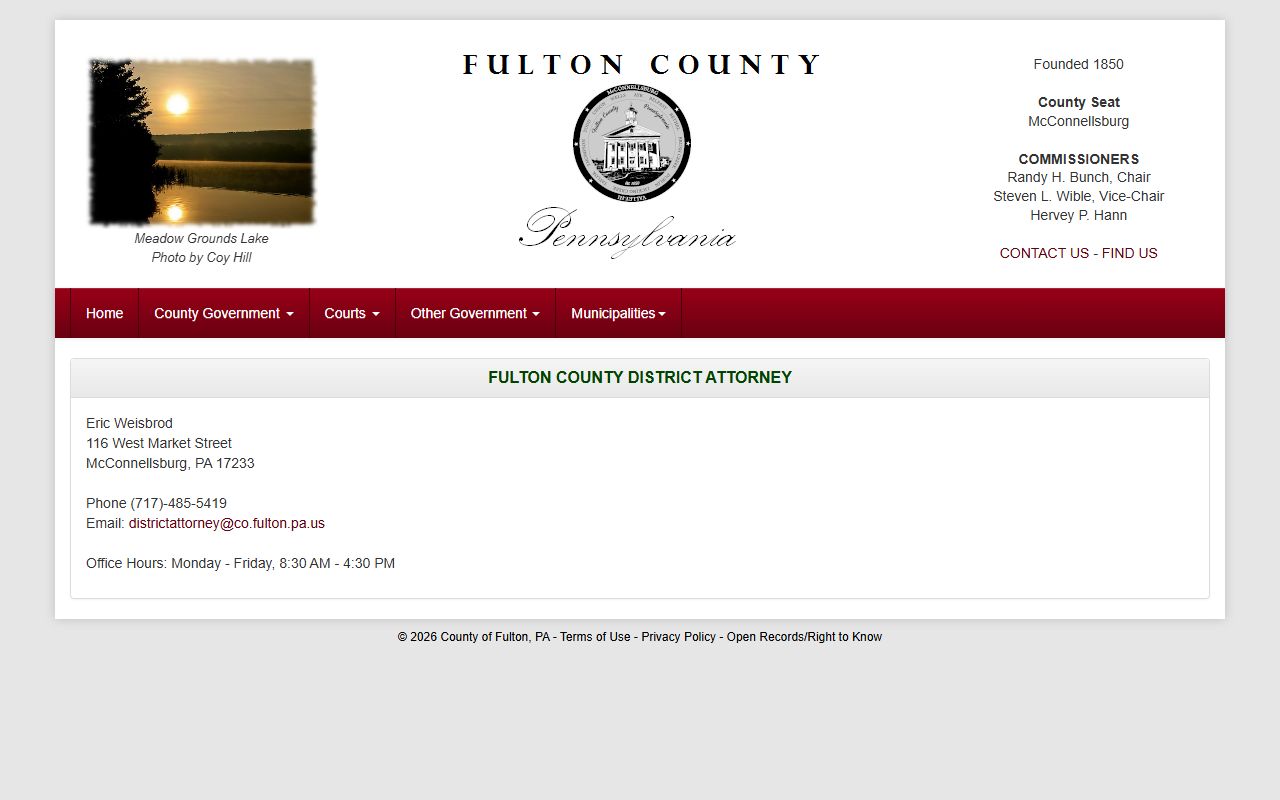
For public case posture, start with UJS and court records. For victim/witness questions or prosecution-office routing, contact the DA office directly, and use Pennsylvania VINE for custody or case notifications where available.